
(C) UPDATED 2026 (2023) ECGcourse.com LLC | Vernon R Stanley, MD, PhD Author | All Rights Reserved.
Please note: Content is not intended to be medical or legal advice. As always, please correlate with patient history, lab results, radiologic studies and current (and old) EKG. Also consult with FP and Cardiology when and where appropriate.
In this blog we will focus on the differential diagnoses to consider when you see T-wave changes on the 12-lead ECG. The verbiage “T-wave Changes” can be often seen on the computer interpretation printout on the 12-lead ECG. This however can have broad meaning and, by itself, is very nonspecific and not very helpful in management of the patient. It is important for the provider to see and note changes on each lead of the 12-lead ECG, correlate with clinical symptoms and compare with an old ECG when available.
Here we will discuss T-wave changes and some general categories into which this phenomenon may fall – normal, hyperacute or peaked and inversion. Please note, this is only a primer to the discussion on T-waves and many factors may impact the T-wave which change the “rules of engagement” (i.e. LBBB, RBBB, WPW to name a few).
ECG T-wave Change Challenge Quiz | Answers at Bottom of Blog
Q1 If tall-peaked (hyperacute) T-wave are observed on a 12-lead ECG, a possible explanation includes all the following except:
- A. Hyperacute T-waves of early MI
- B. Hyperkalemia
- C. Non-specific finding
- D. Hypokalemia
Q2 True or False: Sometimes in the earliest stages of an Acute, evolving MI, T-wave symmetry might be the only change initially apparent.
Q3 A Hyperacute T-wave is classically described by the following terms, except:
- A. Peaked
- B. Broad-based
- C. Tall
- D. Symmetrical
- E. Biphasic
In this blog post, we explore the various waveshapes which the “T-wave” can assume on the 12-lead ECG. First, we review characteristics of a classic, normal T-wave. We then continue on this discussion to review the definition of T-wave changes, specifically a Hyperacute T-wave and T-wave Inversion and what the differential diagnoses may be.
Specifically, we will discuss the following 3 scenarios of the T-wave presentation on the 12-lead ECG:
- Normal T-wave
- Hyperacute (Peaked) T-wave
- T-wave Inversion
1. Characteristics of the T-wave of the Classic, Normal 12-lead ECG
To begin the discussion about the “classic, normal T-wave”, please review the following figure:
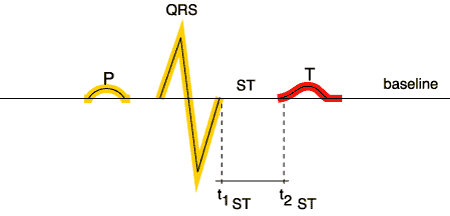
You will notice that the normal T-wave is upright and furthermore is rounded and slightly asymmetrical. It tends to rise slowly and have a steep descent.
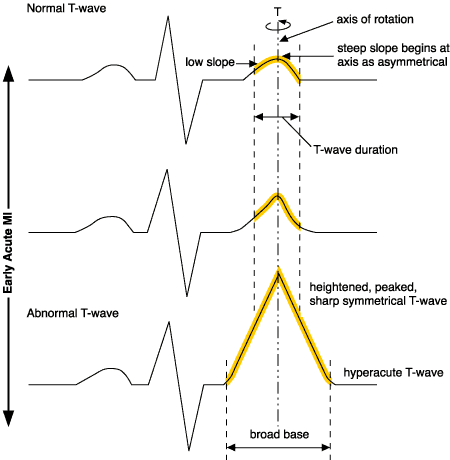
Although counterintuitive, if the T-wave is symmetrical (either inverted or upright) it is suspect for ischemia or infarction, especially if it is pointed and peaked. This change in the T-wave might occur in the very early stages of an acute MI and is characterized by a tendency of the T-wave to be high-peaked, sharp and broadened at the base and symmetrical.
It is important to note that this subtle finding of symmetry in the abnormal T-wave is one that only the discriminating eye will see, but it may be the only abnormality on the 12-lead ECG to suggest acute ischemia or infarction. It is almost as if the acute MI were “pulling up” on the T-waves with an attachment point at the center, causing a broadening of the base, sharp peaking, heightening and symmetry. When this is recognized, the T-waves are described as “hyperacute T-waves“.
The important point is NOT that you should expect yourself to always recognize symmetry vs asymmetry, because the T-wave is often not clearly depicted; but it is important that you always look for it.
The concept of symmetry is demonstrated in the illustration below which shows symmetry around the axis of rotation. For example, if you rotate the T-wave around the axis of rotation, this will reproduce the waveform.
If this mirror image symmetry is present, then this is described as symmetrical T-waves and the ECG is certainly “NOT NORMAL”. The implication of NOT NORMAL is certainly vague and nonspecific and you must know that this covers the gamut from inconsequential to serious to life-threatening. However, as the electrocardiographer, you are not so much interested in the gravity of the abnormality but simply say that the ECG is normal or not normal and to further categorize this into a specific diagnosis, if possible, such as acute MI, old MI, myocardial ischemia, LVH, LBBB, non-specific, IVCD, etc.
You will notice that the T-waves are upright (positive) in all leads of the normal 12-lead ECG, except maybe in Leads V1, avL, avF, III. These four leads in fact often have inverted T-wave and you can certainly have a perfectly normal 12-lead ECG with these inversions. However, these T-wave inversions could represent a subtle sign of ischemia. The truth will more nearly be revealed by comparison with the old ECG. It is not so important that you memorize the four leads which might normally have T-wave inversion but that you know that some leads may have T-wave inversions, and proceed to a reference manual for these specific leads.
Hence, as a part of our routine for the 12-lead ECG analysis, we must carefully scrutinize each lead’s T-wave to determine if the T-wave is upright and asymmetrical.

If this T-wave rule is violated, then you must explain why, or at least acknowledge this finding. The important point is that the ECG is not normal. It has already been seen that you can expect possible T-wave inversion as a part and parcel of LBBB or RBBB as secondary or primary T-wave changes or even the IVCD. Please reference past blog posts: RBBB (Right Bundle Branch Block) & Primary T-wave Changes – ECGcourse.com | Finding a STEMI in the presence of the Left Bundle Branch Block (LBBB) – ECGcourse.com
2. Hyperacute (Peaking) T-waves and Classic STEMI Patterns:
- Hyperacute T-waves are often the 1st abnormality on the 12-lead ECG, within the 1st 30 minutes of vessel occlusion.
- The presence of hyperacute T-waves is often transient and hence serves as a time marker in the early evolution of the STEMI
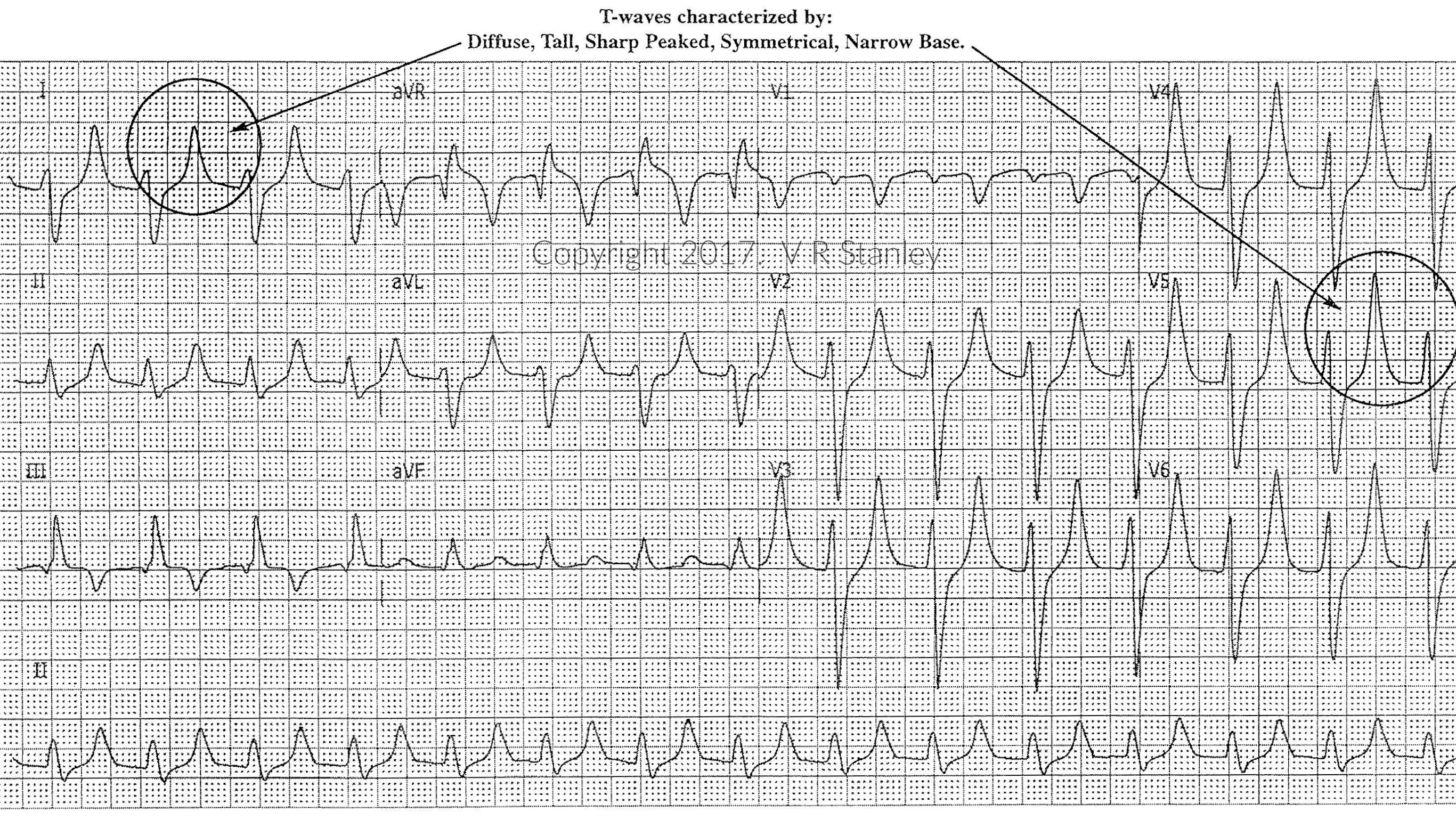
- Hyperacute Ts are typically tall, rounded peak and tending toward symmetrical, broad-based (compared to peaked Ts of hyperkalemia that are tall, sharp-peak, narrow-based (needle-like, symmetrical)
- If suspicious, repeat the ECG every 15 minutes until you detect a pattern or as clinically indicated.
Example Tracing of Hyperacute Ts
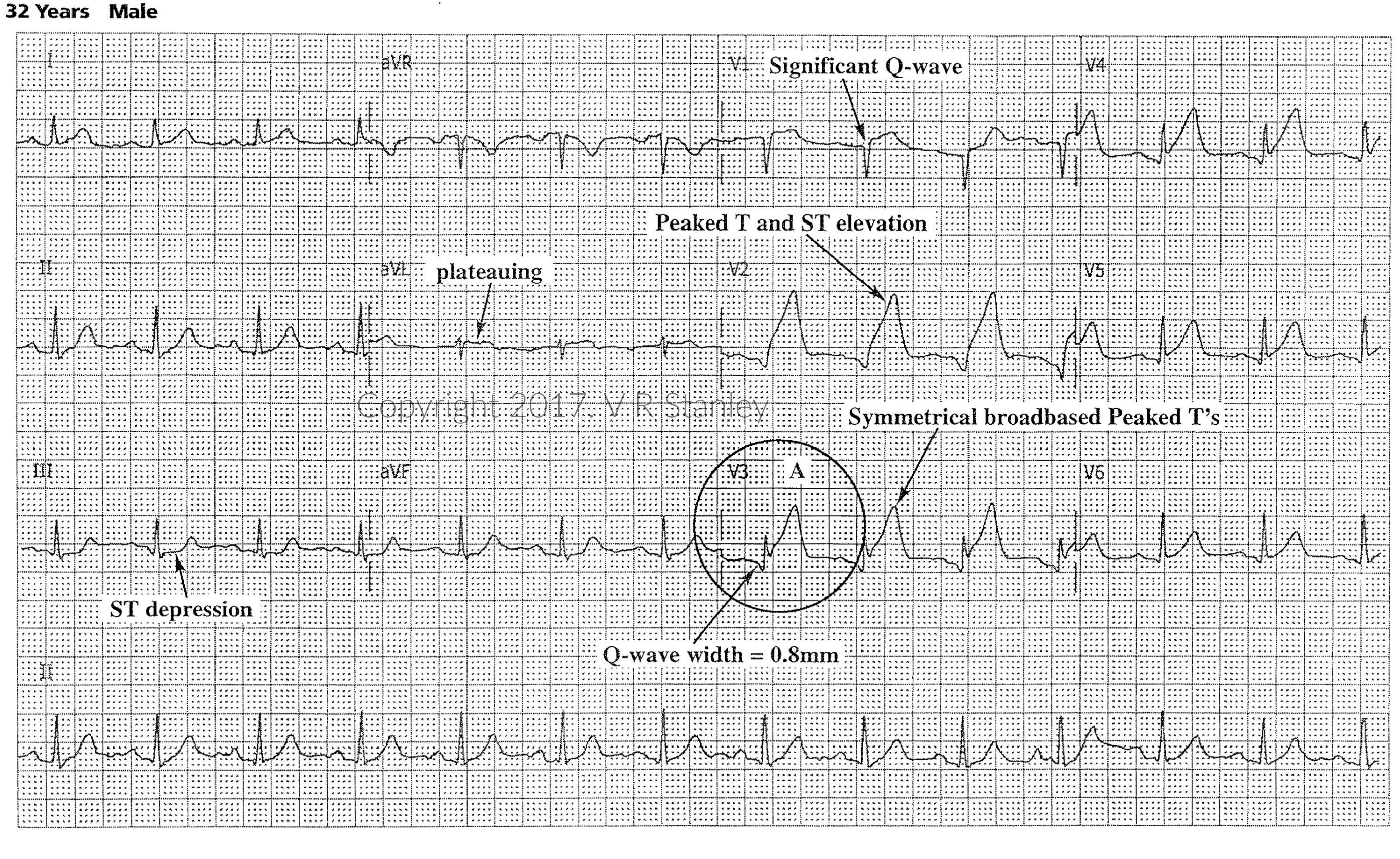
Hyperacute T-waves vs Hyperkalemia
Another common “peaked Ts” cardiogram is the 12-lead ECG of hyperkalemia. In the clinical environment you will frequently encounter the patient with hyperkalemia. As the serum K+ rises, the T-wave will usually increase in height and will become…diffusely tall, sharp peaked, narrow based, symmetrical.
Example Tracing of Hyperkalemia
3. T-wave Inversion
The presence of T-wave inversion in the 12-lead ECG is fraught with a long differential list. Each lead of the 12-lead should be examined carefully and, when available, comparison with an old ECG should be performed. The list of differentials for T-wave changes of inversion includes, but is certainly not limited to the following:
- T-wave inversion associated with LVH (Left Ventricular Hypertrophy)
- T-wave inversion associated with LBBB (Left Bundle Branch Block) or RBBB (Right Bundle Branch Block), WPW (Wolff-Parkinson-White) or IVCD (Intra-Ventricular Conduction Delay)
- T-wave inversion of Infarction, Ischemia or Non-ST-elevation MI
- T-wave inversion associated with the ECG Juvenile pattern
- CNS catastrophe such as stroke or subarachnoid hemorrhage
- Pulmonary embolus
- Most recently, relatively common finding in COVID-19 patients. (If T-wave inversion a new finding, it may be associated with increased hospitalization, mechanical ventilation and increased mortality. See full article.)
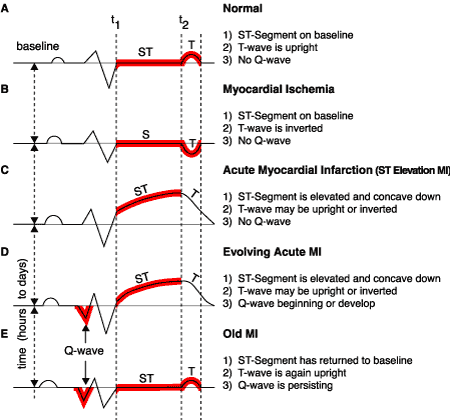
In this blog, we will focus specifically on #3 in the list below. But please note, that the following list may cause T-wave inversion. For further discussion, please visit the full post on T-wave Inversion. This is also covered on the cheat sheet, HEART Ruler Pocket Guide:
- T-wave inversion Associated with LVH
- T-wave inversion Associated with LBBB or RBBB
- T-wave inversion of Ischemia or non-ST Elevation MI
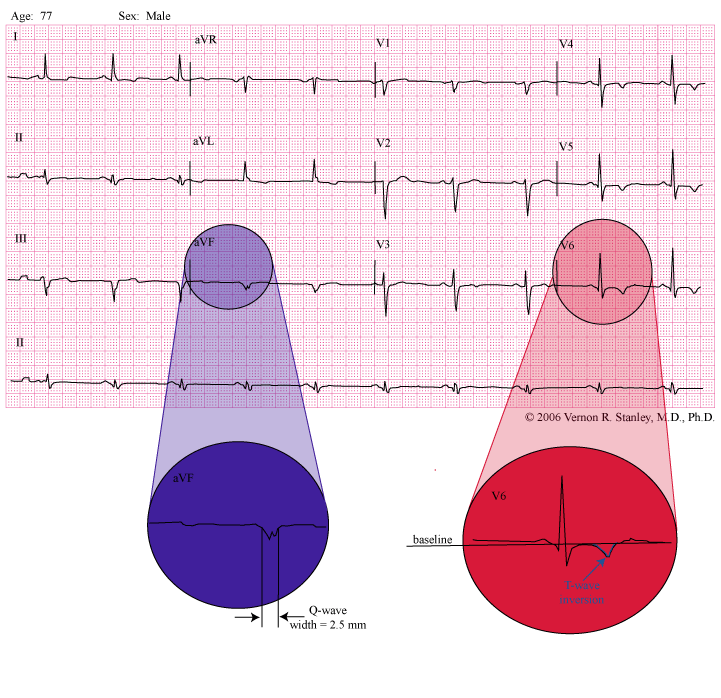
Please evaluate the 12-lead ECG tracing below of a 77-year-old male with chest tightness and shortness of breath. The admission tracing 24 hours earlier was “normal”. Your interpretation given to the private attending would be as follows:
INTERPRETATION:
The significant Q-waves in Leads III and avF are consistent with inferior infarction (age unknown). It might be a normal variant unless shown to be new.
T-wave inversion Leads I, avL, V4, V5 and V6 consistent with lateral/highlateral myocardial ischemia or non-ST-elevation MI (non-STEMI). The attending should be notified immediately.
DISCUSSION:
There are two noteworthy points of this tracing:
- 1. Significantly wide Q-waves in Leads III and avF (i.e.Q-wave duration > 1mm [0.04 sec]).
- 2. T-wave inversion in Leads V4, V5, V6, I and avL.
First, let us look at the magnified Lead avF. I have labeled the Q-wave width as 2.5 mm. We will consider significantly wide Q-waves as > 0.04 sec.
DIFFERENTIAL MEANING OF SIGNIFICANTLY WIDE Q-WAVES
- 1. Myocardial infarction (usually old, although the Q-wave might develop over only a few hours during the evolution of an acute MI).
- 2. LBBB.
- 3. LVH.
- 4. WPW.
- 5. LAFB.
- 6. IVCD.
- 7. Might be a normal variant especially in Leads II, III, aVF, aVL (must have old tracing for comparison and old clinical record)
- 8. Ventricular aneurysm.
Important Special Case Regarding Significant Q-waves:
During your practice you will occasionally find significantly wide Q-waves in Leads II, III and avF, and you will find this to be normal for that patient (i.e. a normal variant). As indicated above, this conclusion can only be drawn by clinical correlation and comparison with the old cardiogram.
Now let us look at the magnified view of Lead V6. Note the colored and labeled T-wave inversion. This is also seen in Leads I, avL, V4 and V5.
DIFFERENTIAL MEANING OF T-WAVE INVERSION (partial list)
- 1. Myocardial ischemia.
- 2. Myocardial infarction (acute non-STEMI).
- 3. LVH with ST-T changes (strain).
- 4. T-wave changes secondary to LBBB, RBBB, WPW or IVCD.
- 5. Non-specific changes.
- 6. Juvenile pattern.
- 7. CNS catastrophe such as stroke or subarachnoid hemorrhage.
- 8. Pulmonary embolus.
- 9. T-wave inversions of reciprocity.
- 10. Hyperventilation syndrome.
ECG Interpretation (tracing immediately above.)
- The significant Q-waves in Leads III and avF are consistent with inferior infarction (age unknown). It might be a normal variant unless shown to be new.
- T-wave inversion Leads I, avL, V4, V5 and V6 consistent with lateral/highlateral myocardial ischemia or non-ST-elevation MI (non-STEMI). The attending should be notified immediately.
Answer Key
Q1 If tall-peaked (hyperacute) T-wave are observed on a 12-lead ECG, a possible explanation includes all the following except:
- A. Hyperacute T-waves of early MI
- B. Hyperkalemia
- C. Non-specific finding
- D. Hypokalemia
Q2 True or False: Sometimes in the earliest stages of an Acute, evolving MI, T-wave symmetry might be the only change initially apparent.
TRUE
Q3 A Hyperacute T-wave is classically described by the following terms, except:
- A. Peaked
- B. Broad-based
- C. Tall
- D. Symmetrical
- E. Biphasic
Other recommended reading:
For comprehensive 12-lead ECG Coverage: 12-Lead ECG Interpretation Course: Basic & Advanced Learning
For providers: T wave • LITFL • ECG Library Basics
The physiology: The T-wave: physiology, variants and ECG features –
For patients & students: Should I Worry About a T Wave Abnormality? – ScienceInsights
-
Women’s HEART Acronym Fitted T-Shirt
Original price was: $28.99.$24.00Current price is: $24.00. -
Unisex HEART Mnemonic Long Sleeve Black T-shirt
Original price was: $39.50.$34.00Current price is: $34.00.